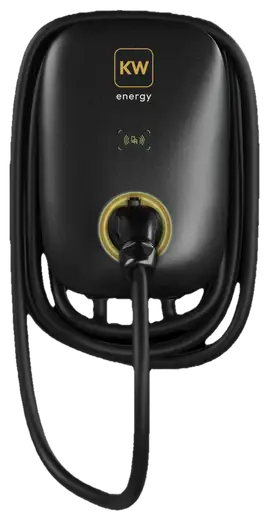
Pick a commercial EV charger for your business model: charge as a benefit for employees, condo and strata residents, and fleets, or charge as a service for retail customers and parking guests. Every model is cETLus certified, rated to −30 °C, and shares power through KW Energy load management, so more stalls fit on your existing service. Same OCPP backbone, $0 CMS subscription on KW Energy chargers.
Commercial
EV chargers, Level 2.
Two paths, one platform.
Two chargers. Two business models. One OCPP backbone.
First, one question: do you charge for it?
Every commercial Level 2 buying decision starts here. Charging as a benefit and charging as a service look similar from the parking lot, but the firmware, payment hardware and ROI math are completely different. Pick the right path and the rest of the decision tree gets simple.
Charging as a benefit.
Power is a perk you provide. Authenticate users; don’t bill them.
- A workplace, head office, or campus offering employee charging
- A condo, strata or rental building serving residents
- A fleet depot: last-mile, transit, municipal, school bus
- A government / institutional site (hospital, university)
Charging as a service.
Drivers pay you per session, per minute, or per kWh (following Measurement Canada rules). You set the rate, and KW Energy Pay, the automated settlement layer in KW Energy CMS, pays you monthly.
- A retail store, mall, or grocery that wants longer customer visits
- A parking garage, surface lot, or paid-parking facility
- Hotel, restaurant, or destination hospitality
- A municipal site or branded charging network operator
Two commercial chargers.
48 A or 80 A.
Gust is for free charging you provide; Squall is for charging drivers pay for. Each comes as a 48 A (11.5 kW) or 80 A (19.2 kW) model with a 7.6 m (25 ft) cable, a status display and a −30 °C to +50 °C rating. Both run the same OCPP and KW Energy firmware, with KW Energy load management, the dynamic load management layer in KW Energy CMS, on every port.
Gust-48
Free charging for staff, residents and fleets. RFID access, status display, IP65, rated to −30 °C.
Gust-80
Full 80 A for fleets with high-amp EVs. RFID access, status display, IP65, rated to −30 °C.
Squall-48
Drivers pay by QR code, card or Apple/Google Pay. Status display, IP65, rated to −30 °C.
Squall-80
Full 80 A paid charging. QR code, card or Apple/Google Pay. Status display, IP65, rated to −30 °C.
Six layouts. Pick your port density.
Gust-48, Gust-80, Squall-48 and Squall-80 all ship in the same six hardware configurations. Pick the layout that matches your parking design, then the model that matches your business model. Available on all four models.
Single Charger
Single-port wall mount. The volume-leader configuration.
Single + Retractor
Overhead cable retractor, keeps the cable off the ground.
Single + Pedestal
Freestanding on a fixed pedestal, for surface lots without walls.
Dual Back-to-Back
Two ports, one pedestal, covers two parking spots facing opposite directions.
Dual Side-by-Side
Two ports facing the same direction, covers two adjacent parking spots.
Dual Wire Management
Two ports + two overhead retractors, premium fleet & retail.
24 commercial Level 2 EV charger configurations.
Every commercial EV charger SKU we ship, with its configuration, amperage and port count, listed below. Model starting prices are live prices in CAD from our Canadian store.
| SKU | Configuration | Ports | Amps | Power |
|---|---|---|---|---|
| GUST-48-S | Single Charger | 1 PORT | 48 A | 11.5 kW |
| GUST-48-R | Single + Retractor | 1 PORT | 48 A | 11.5 kW |
| GUST-48-PS | Single + Pedestal | 1 PORT | 48 A | 11.5 kW |
| GUST-48-PBB | Dual Back-to-Back | 2 PORTS | 48 A | 11.5 kW |
| GUST-48-PSS | Dual Side-by-Side | 2 PORTS | 48 A | 11.5 kW |
| GUST-48-PW | Dual Wire Mgmt | 2 PORTS | 48 A | 11.5 kW |
| GUST-80-S | Single Charger | 1 PORT | 80 A | 19.2 kW |
| GUST-80-R | Single + Retractor | 1 PORT | 80 A | 19.2 kW |
| GUST-80-PS | Single + Pedestal | 1 PORT | 80 A | 19.2 kW |
| GUST-80-PBB | Dual Back-to-Back | 2 PORTS | 80 A | 19.2 kW |
| GUST-80-PSS | Dual Side-by-Side | 2 PORTS | 80 A | 19.2 kW |
| GUST-80-PW | Dual Wire Mgmt | 2 PORTS | 80 A | 19.2 kW |
| SKU | Configuration | Ports | Amps | Power |
|---|---|---|---|---|
| SQUALL-48-S | Single Charger | 1 PORT | 48 A | 11.5 kW |
| SQUALL-48-R | Single + Retractor | 1 PORT | 48 A | 11.5 kW |
| SQUALL-48-PS | Single + Pedestal | 1 PORT | 48 A | 11.5 kW |
| SQUALL-48-PBB | Dual Back-to-Back | 2 PORTS | 48 A | 11.5 kW |
| SQUALL-48-PSS | Dual Side-by-Side | 2 PORTS | 48 A | 11.5 kW |
| SQUALL-48-PW | Dual Wire Mgmt | 2 PORTS | 48 A | 11.5 kW |
| SQUALL-80-S | Single Charger | 1 PORT | 80 A | 19.2 kW |
| SQUALL-80-R | Single + Retractor | 1 PORT | 80 A | 19.2 kW |
| SQUALL-80-PS | Single + Pedestal | 1 PORT | 80 A | 19.2 kW |
| SQUALL-80-PBB | Dual Back-to-Back | 2 PORTS | 80 A | 19.2 kW |
| SQUALL-80-PSS | Dual Side-by-Side | 2 PORTS | 80 A | 19.2 kW |
| SQUALL-80-PW | Dual Wire Mgmt | 2 PORTS | 80 A | 19.2 kW |
Gust and Squall current setting (DIP switch)
Set by a qualified electrician to match the circuit. The breaker must be rated for the setting, for example 80 A on a 100 A breaker.
| Switch | Current | Power at 240 V |
|---|---|---|
| 0 | 8 A | 1.9 kW |
| 1 | 16 A | 3.8 kW |
| 2 | 24 A | 5.8 kW |
| 3 | 32 A | 7.7 kW |
| 4 | 40 A | 9.6 kW |
| 5 | 48 A | 11.5 kW |
| 6 | 56 A | 13.4 kW |
| 7 | 64 A | 15.4 kW |
| 8 | 72 A | 17.3 kW |
| 9 | 80 A | 19.2 kW |
Tell us your site and port count. We reply with configurations, volume pricing, electrical pre-work (including EVEMS load management under CEC Rule 8-106) and provincial program options, usually within one business day.
Match your vertical to the right model.
Four verticals cover most commercial Level 2 deployments. Each one has a family pairing we recommend and a Markets page with deeper guidance: site design, electrical pre-work, provincial programs, and ROI templates.
Workplace
Employee charging as a benefit. Authenticate by RFID or app; power’s on the company tab.
Condo & Strata
Condo, strata and rental charging. Resident-assigned ports, RFID auth, load sharing on the building’s service, no payment kiosk needed.
Fleet Depot
Last-mile delivery, transit, municipal, utility and service fleets. High port density, dynamic load mgmt critical.
Retail & Hospitality
Stores, malls, hotels, paid lots. Drivers pay by card (QR code on Squall-48 and Squall-80); you set the rate and capture revenue.
Level 2 or DC fast? You don’t always need DCFC.
DC fast charging gets the headlines, but for the vast majority of commercial sites, workplaces, fleets, condo and strata buildings, retail with dwell time, Level 2 is the right answer. 10× lower cost per port, no transformer upgrade, and dwell time covers the kWh gap. Here’s the math, and our guide to choosing Level 2 vs DC fast by dwell time.
L2: this page
Best for sites where vehicles dwell more than 30 minutes.
- Existing electrical: many sites have spare 208/240 V capacity, and EVEMS load management (CEC Rule 8-106) stretches it further
- Provincial permit in days, not months; utility coordination is often not needed
- 10× more ports for the same CapEx as a single DCFC stall
- Lower demand charges: gentler on utility billing
DCFC
Best for highway corridors and short-dwell retail (under 30 min).
- Permitting + utility coordination, typically 3–9 months
- Civil works (concrete pad, conduit) add significant cost
- Premium revenue per session, several times a Level 2 session
- Highway corridors and short-dwell sites where speed matters most
Dwell time covers the kWh.
- Vehicles park 2+ hours (workplace, condo, hotel, mall)
- Fleet recharges overnight at the depot
- You need 8+ ports and a single utility service
- You want to ship and energize within weeks, not quarters
- Budget is constrained: port density matters more than speed
Dwell time is short.
- Highway corridor: drivers stop 20–40 min
- Quick-service retail (gas station, convenience, fast casual)
- Fleet midday top-up between routes
- Public charging where higher per-session revenue justifies CapEx
- Site has spare 3-phase capacity (208 V or 600 V), or the upgrade is funded
Commercial Level 2 EV charger questions.
Ten questions we hear most often from Canadian commercial buyers. Don’t see yours? Reach our commercial team.
What’s the difference between monetized and non-monetized commercial EV chargers?
How much does a commercial Level 2 EV charger cost in Canada?
How many Level 2 chargers can my electrical service support?
Can condo and strata buildings install KW Energy chargers?
Are KW Energy commercial chargers OCPP compliant, and can I use my own network?
What payment methods does Squall support?
Do KW Energy commercial chargers support the NACS (Tesla) connector?
What’s the warranty on commercial chargers?
Can KW Energy chargers be installed for accessible parking stalls?
Do commercial chargers keep working through a Canadian winter?
Tell us about your site.
Our commercial team will scope ports, configurations, electrical pre-work, EVEMS load management and provincial programs, with pricing in CAD, usually within one business day. No quote walls, no gatekeeping.